September 3, 2026
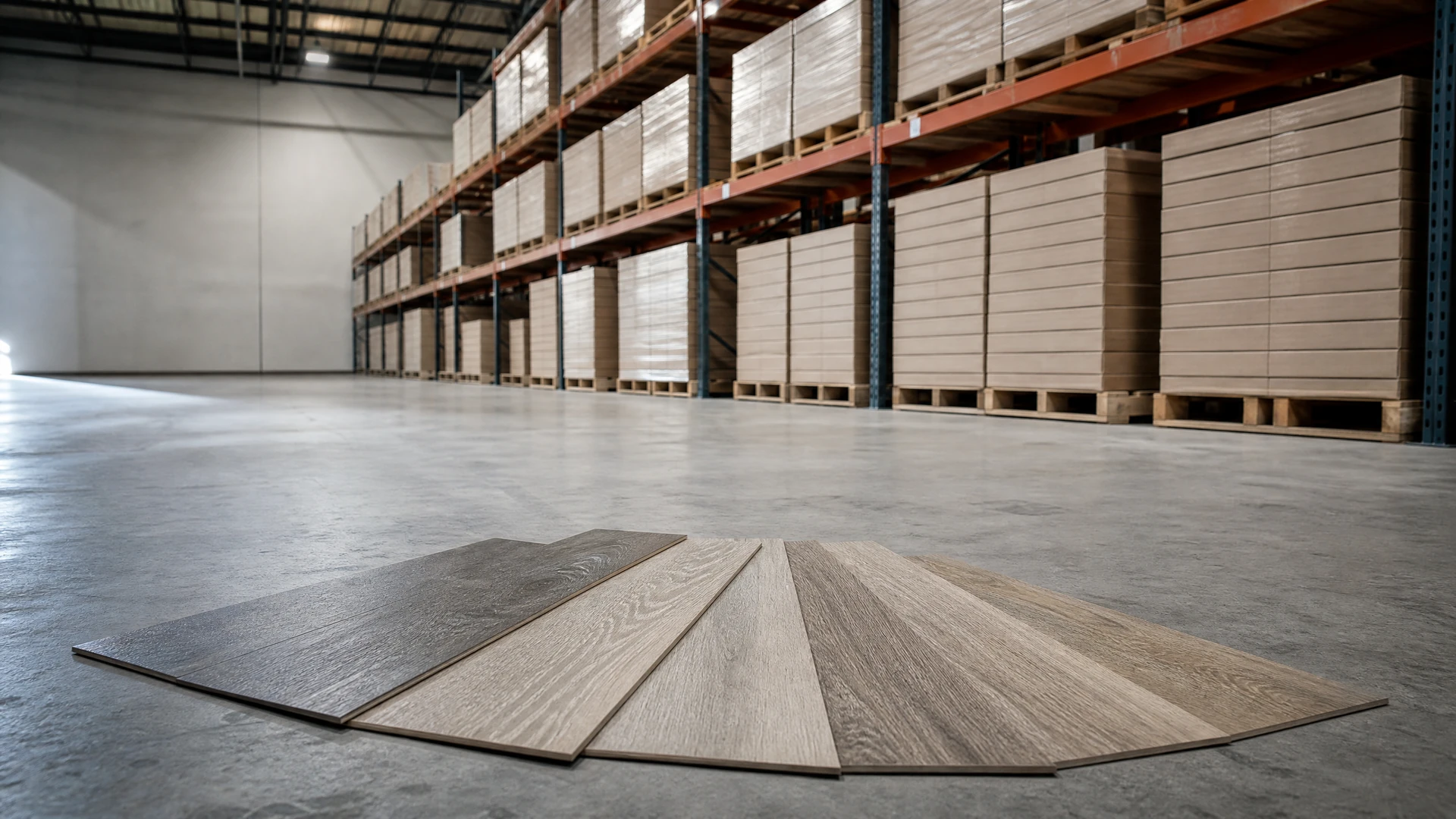
Quick answer: Both are legitimate. A home improvement store is built around a narrow set of products held in volume, which makes it excellent when you need something standard, today, on a Saturday. A flooring store is built around selection and specification, which makes it better when the floor has to last, match something, or cover a lot of square footage. The practical difference shows up in one number: the wear layer, measured in mils. Ask for it in both places. If one of them cannot tell you, that tells you which one is quoting on price alone.
We are a flooring store, so read this knowing that. We have also tried to write the version we would want if we were the ones shopping, including the part where we tell you to go to the big box instead.
A home improvement store is a volume operation. It stocks a curated set of products, deep, so that anyone can walk in and leave with flooring in a cart. That is a genuine service and it is hard to do. The tradeoff is that the assortment is chosen for broad appeal and shelf turnover, not for the specific job you are doing.
A flooring store is a sourcing operation. The showroom is a sample of what we can order, not the limit of it. We carry our own collections, and beyond those we order from a wide catalog. The tradeoff is that most of it is not sitting on a shelf ready to load into your truck.
Neither model is better. They are answers to different questions.
If you take one thing from this page, take this.
Luxury vinyl plank is sold with two thickness numbers, and people routinely compare the wrong one.
Overall thickness is measured in millimeters. It describes how the plank feels underfoot and how forgiving it is over an imperfect subfloor.
The wear layer is measured in mils, and a mil is one thousandth of an inch. For scale, a human hair runs about three to four mils. This is the clear layer protecting the printed surface, and it is what actually determines how long the floor survives a dog, a dining chair, or a family.
Here is the part that costs people money: the two numbers are unrelated. A thick, substantial-feeling 10mm plank can carry a 12 mil wear layer, and a thinner 5mm plank can carry 20 mil. The thin one will outlast the thick one. Picking up two samples and choosing the heavier one is a reasonable instinct and it is often exactly wrong.
Manufacturers tie warranty length to this number, which tells you they take it seriously. A 20 mil product commonly carries lifetime residential coverage with a light commercial term attached.
So the question to ask in any store is simply: what is the wear layer in mils?
Not how thick is it. Not is it waterproof, because nearly all of it is. Mils.
We would rather be useful than win every sale.
You need it today, or it is Saturday. Our showroom on Riley Fuzzel Road is open weekdays, 9 to 5. If you are doing the work this weekend and you need material in the truck now, that is a real constraint and the big box solves it.
It is a small patch or a single closet. Driving across town for a quote on 40 square feet is not a good use of your Tuesday.
You are matching something you already bought there. If the rest of your house came from a big box line, the match is going to be easiest at the same source.
You want the cheapest builder-grade option and you know it. If the plan is a rental turnover on the lowest-cost product available and longevity is genuinely not the goal, there is nothing wrong with that and we will not pretend otherwise.
Your project is one room and you have no plans to expand it. Volume pricing needs volume to mean anything.
The square footage is significant. Volume pricing is the entire reason wholesale exists. On a whole-house job the difference is not a coupon, it is a line item.
You want specific performance, not just a look. A 20 mil wear layer in the kitchen and something lighter in the guest room is a sensible plan, and it requires a store that can actually source both.
You need it to match or coordinate. Flooring plus cabinets plus trim, sourced together and checked against each other in the same light, avoids the thing where two products that looked fine separately fight in the actual room.
You are a contractor or builder. Pricing you can estimate against, sourcing that responds to rush work, and delivery timed to the job schedule are different requirements from retail, and they need a supplier set up for them. Ours is on our contractors page.
You want to know who is installing it. Ask in either place. The answer matters more than the brand on the box.
Our collections carry our name: Lonestar Wood, Luxury Vinyl, Plus, Max, Cloud 9, Comfort, Heaven's Door, Oasis, and commercial carpet tiles.
Private label is worth understanding rather than trusting on faith. When a store puts its own name on a product, it is buying direct from a mill and skipping the national brand's marketing cost. That is genuinely where the savings come from, and it is why a customer told us our product was "so much better quality than what I've seen in big box stores and it saved me money on top of that."
It also means you cannot look up reviews of the exact SKU. So the burden shifts back to specs. Ask us for the wear layer, the core type, the thickness, and the warranty, in writing. Any private label worth buying will hand those over without hesitating. Ours are on the warranty page, which lists 15 to 25 year residential wear coverage on luxury vinyl and 25 to 50 year structural coverage on engineered hardwood.
A store that answers all five quickly is a store worth buying from, whatever the sign out front says.
Is flooring cheaper at a flooring store or a home improvement store?
It depends on volume. For a small job the big box is often competitive and more convenient. For whole-house square footage, a wholesale flooring store's pricing model is built around exactly that, and the gap widens as the job grows.
What is a wear layer and why does it matter more than thickness?
The wear layer is the clear protective layer over the printed surface of vinyl plank, measured in mils, where a mil is one thousandth of an inch. Overall thickness is measured in millimeters and describes feel underfoot. A thicker plank with a thin wear layer will wear out before a thinner plank with a thick one.
Do big box stores sell lower quality flooring?
Not inherently. They sell a narrower assortment chosen for volume, which includes both good and entry-level products. The issue is usually that the specification is not on the shelf tag, so shoppers compare on price and appearance without knowing what they are comparing.
Can I get flooring the same day at a flooring store?
Sometimes, on stocked items. A flooring store's model is generally to order from a broad catalog rather than hold everything in inventory, so if same-day pickup is the requirement, call first and ask what is actually in stock.
Is private label flooring good?
It can be very good. Private label means the store buys direct from a mill and skips the national brand's marketing cost, which is where the savings come from. Since you cannot look up reviews of the specific SKU, ask for the wear layer, core type, thickness, and warranty in writing before buying.
What should I bring to a flooring showroom?
Room measurements, a photo of the space in daylight, and a sample or photo of anything the floor needs to coordinate with, such as cabinets or trim. Our post on what to consider before you visit covers the rest.
Bring a photo of the product you are considering anywhere else, and we will tell you its wear layer, its core, and what it should cost at your square footage. If the honest answer is that you should buy it where you found it, we will say so.
Lonestar Flooring and Cabinets, 1208 W Riley Fuzzel Rd, Spring, TX 77373. Call (281) 364-7788. Open weekdays 9 to 5, serving Spring, The Woodlands, Conroe, and the greater Houston area.
Texas Style Wholesale.
Wear layer service-life ranges reflect published industry guidance and vary by manufacturer and use; confirm the specification for any product before purchase. Warranty terms cited from our own warranty page. Customer quotation from a published Google review. Retail comparisons describe general business models rather than any specific competitor's current pricing or assortment.

.svg)
.svg)