September 7, 2026
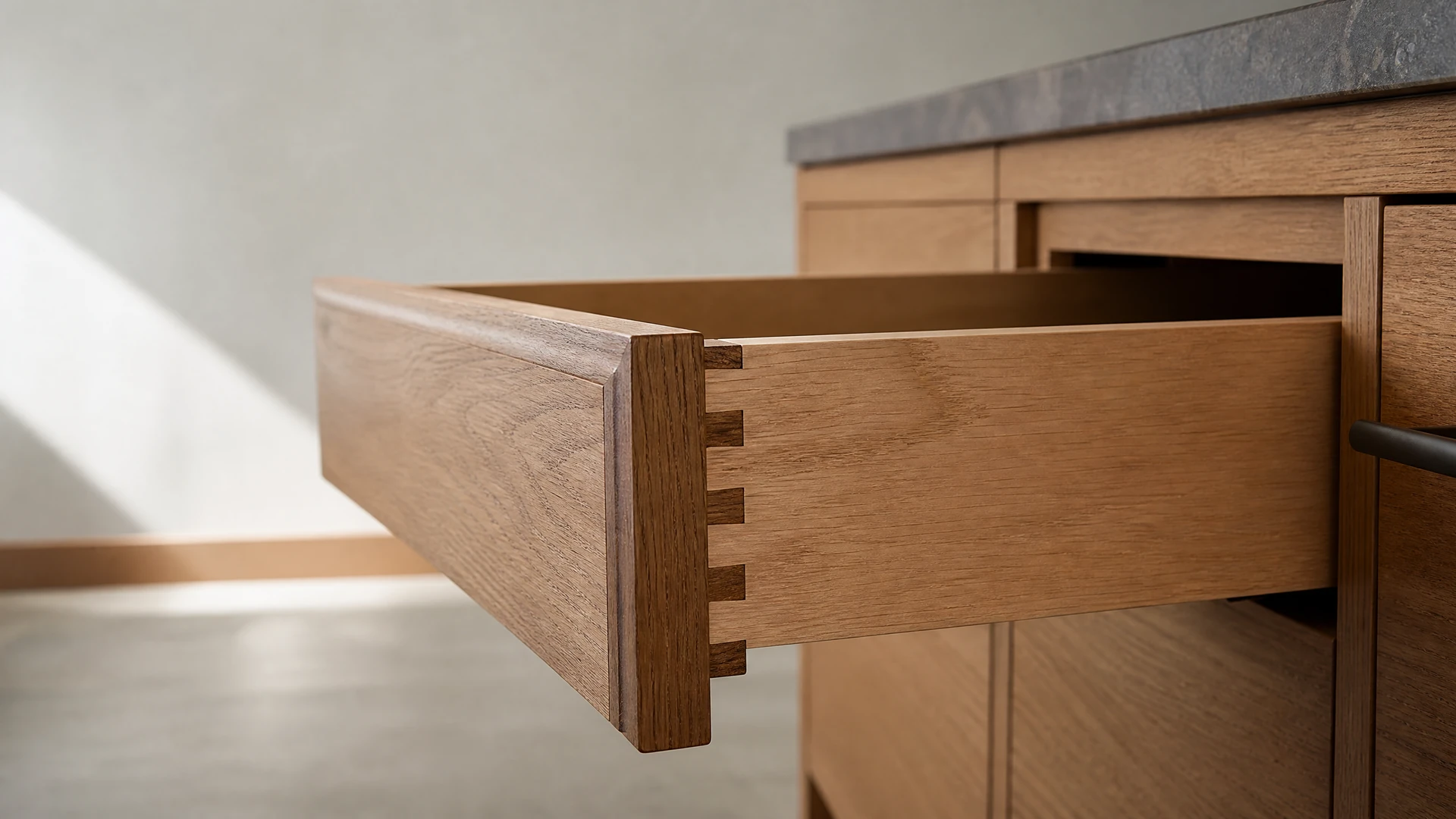
Quick answer: With the doors shut, a cheap cabinet and a good one look nearly the same, which is exactly the problem. The differences live in four places you can check in about two minutes. Pull a drawer all the way out and look at how the corner is joined, because dovetails or interlocking joints beat staples driven into end grain. Press on the side panel of the box and see whether it flexes. Open and close a door to feel whether the hinge is smooth and whether it has visible adjustment screws. And check whether the drawer bottom sits in a groove on all four sides or is simply tacked on underneath. Those four checks separate cabinets that last twenty years from cabinets that sag in five.
Cabinets are usually the largest line item in a kitchen and the one people have the least vocabulary for. Flooring at least gets compared on thickness. Cabinets tend to get compared on door color.
1. The drawer corner. Pull a drawer completely out and look at where the front meets the side. Dovetail joints, which interlock like fingers, or another mechanical joint, mean the corner is holding itself together. Staples or brads driven into end grain mean the corner is relying on fasteners in the weakest direction wood offers. Drawers carry weight and get yanked, and that corner is where failure starts.
2. The drawer bottom. It should sit captured in a groove on all four sides. A bottom that is stapled to the underside of the box will eventually sag or drop out under a load of pans. This is a thirty second check almost nobody makes.
3. The box itself. Press firmly on the middle of a side panel. Quality construction uses plywood or dense engineered panel that holds a screw and resists twisting, and it should feel substantial rather than flexible. A panel that gives under thumb pressure will not hold a heavy shelf load flat over years.
4. The hardware. Open a door and a drawer. Full extension glides should feel smooth and steady, not gritty or bouncy, and should let you reach the back of the drawer instead of stopping short. Soft close should catch the door gently rather than slamming. Look for visible adjustment screws on the hinges, because houses settle and doors that can be realigned stay square. Blum, Hettich, and Grass are the names worth recognizing.
There is a persistent internet argument that plywood is always right and particleboard is always garbage. That is too simple.
Plywood holds screws well, resists twisting, and tolerates moisture better if there is ever a leak under a sink. It is generally the stronger box and it costs more.
Dense engineered panel, meaning good particleboard or furniture-grade MDF, is flatter and more dimensionally stable than plywood, which matters for door and panel faces that need to stay true. Quality varies enormously by density. Cheap particleboard is genuinely bad. Dense engineered panel from a real cabinet manufacturer is not.
Where the distinction earns its money is under the sink, in the cabinet most likely to meet water. If you are going to spend up on one box, spend it there.
The honest summary: box material matters, but a well-built dense-panel box with dovetailed drawers and good hardware beats a plywood box with stapled drawers and cheap glides. Look at the whole cabinet rather than one spec.
Both are legitimate. Neither is a quality tier.
Framed cabinets have a solid face frame across the front of the box. The frame adds rigidity and gives the doors something substantial to mount to. It is the traditional American construction, and it suits traditional and transitional kitchens. The tradeoff is that the frame narrows the opening slightly, so drawer boxes are a little smaller.
Frameless, sometimes called full access or European, skips the face frame. Doors mount directly to thicker box sides, giving you the full width of the opening and a cleaner, more contemporary line. Because there is no frame doing the stiffening, frameless depends more on thicker side panels and precise hardware. Done well it is excellent. Done cheaply it racks.
Choose on the look you want and the storage you need, then judge quality inside whichever you pick.
A good finish is a multi-coat cured system that handles spills, steam, and repeated cleaning. Run a hand along an edge and around a profile. It should feel smooth and evenly colored, with no rough patches, thin spots, or exposed raw material where the door was routed.
Finish failure is slow. It shows up two years in as dulling around the handles and the cabinet nearest the dishwasher, long after the sale, which is precisely why it is worth two minutes at the showroom.
We sell cabinets, and this is still true.
If the boxes are solid, replace the doors instead. If you press the sides and nothing flexes, the drawers run smoothly, and the layout works, then the boxes are fine and you are paying to replace the part that is not broken. Replacing just doors and drawer fronts can cut the cost substantially compared with full replacement and takes a fraction of the time. Our post on summer remodels covers this route.
If the only real complaint is hardware. New knobs and pulls, plus soft close hinges added to existing doors, is a genuinely transformative afternoon at a fraction of the cost.
If you are moving within two years. Cabinets rarely return their full cost in a quick sale, and a clean, well-maintained existing kitchen often shows nearly as well.
If the layout is the actual problem. New boxes in the same bad layout is an expensive way to keep a kitchen that does not work. That is a design conversation before it is a cabinet purchase.
Since we sell both, one practical note that saves people money and trouble.
Decide both together, and view the samples in the same light, in the room they are going into. Cabinet doors and flooring that look fine separately can clash badly once they share a space, because undertone matters more than color. Warm cabinets against cool grey plank is the classic mismatch, and it is only visible when the two are side by side.
On order of operations, talk to your installer before finalizing the schedule. Flooring under cabinets versus flooring installed around them affects appliance heights, dishwasher clearance, and future replacement, and it should be a decision rather than an accident.
How can I tell if kitchen cabinets are good quality?
Pull a drawer fully out and check the corner joint, since dovetail or interlocking joints beat staples into end grain. Confirm the drawer bottom sits in a groove on all four sides. Press the box side panel to see whether it flexes. Then test the glides and hinges for smooth motion and look for visible hinge adjustment screws.
Are plywood cabinets better than particleboard?
Plywood holds screws better, resists twisting, and tolerates moisture better, which matters most under the sink. But dense engineered panel from a quality manufacturer is flat, stable, and perfectly good. A well-built engineered-panel box with dovetailed drawers and good hardware beats a plywood box with stapled drawers.
What is the difference between framed and frameless cabinets?
Framed cabinets have a solid face frame across the front, which adds rigidity and suits traditional styles but slightly narrows the opening. Frameless cabinets mount doors directly to thicker box sides, giving full-width access and a contemporary look while depending more on panel thickness and precise hardware. Both can be high quality.
Should I replace my cabinets or just the doors?
If the boxes do not flex, the drawers run smoothly, and the layout works, replacing doors and drawer fronts is usually the better value. It can cut cost substantially against full replacement and takes far less time. Full replacement makes sense when boxes are failing or the layout itself is the problem.
What hardware brands should I look for?
Blum, Hettich, and Grass are the names most often associated with durable glides and hinges. More important than the brand is the behavior: full extension so you can reach the back, smooth and steady motion, soft close that catches rather than slams, and visible adjustment screws so doors can be realigned as the house settles.
Should I pick cabinets or flooring first?
Pick them together and look at the samples side by side in the actual room's daylight. Undertone mismatches between cabinets and flooring are the most common regret, and they are invisible until the two are compared directly.
Come to the showroom and do all four checks on our cabinets. Pull the drawers out, press the panels, feel the hinges. If you are comparing a quote from somewhere else, bring it and we will tell you what the specification actually says.
Lonestar Flooring and Cabinets, 1208 W Riley Fuzzel Rd, Spring, TX 77373. Call (281) 364-7788. Open weekdays 9 to 5, serving Spring, The Woodlands, Conroe, and greater Houston.
Texas Style Wholesale.
Related reading:- Products and collections- Warranty- Summer remodel in Spring TX: flooring and cabinets- Contractors- Builders
Cabinet quality indicators reflect published industry guidance on construction and hardware. Specific products vary by manufacturer; inspect the actual cabinet you are buying. Warranty coverage for cabinetry varies by manufacturer, as noted on our warranty page.

.svg)
.svg)