September 21, 2026
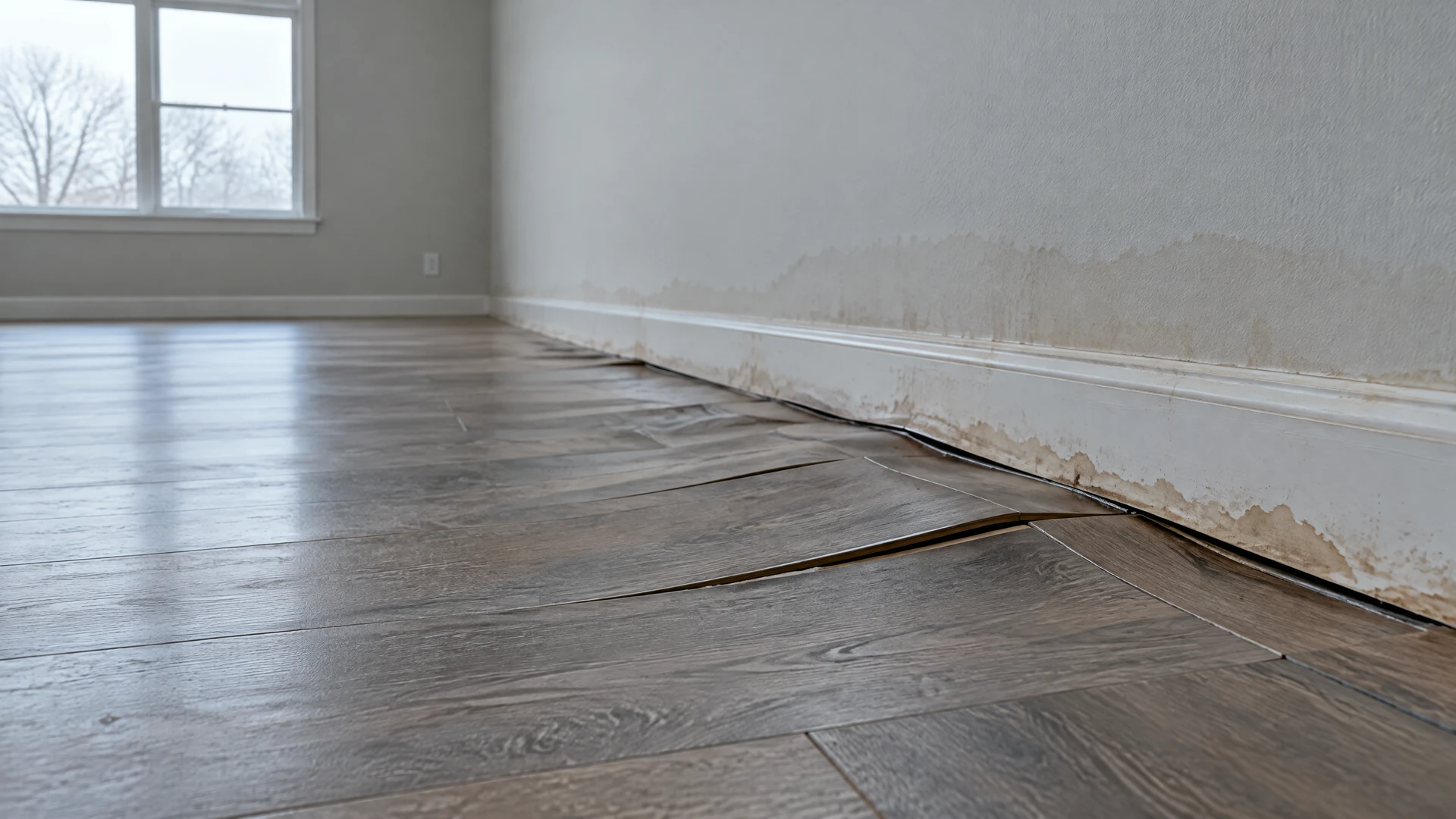
A supply line fails in the kitchen and ruins the flooring in the kitchen and the hallway. Most homeowners assume the insurer will replace the flooring throughout the connected living space so it matches. In Texas that assumption is not supported by law. Texas has no matching statute or regulation, and Texas courts have generally held that an insurer owes for the damaged material, not for undamaged material that happens to be next to it. Knowing that before you file changes how you plan the repair.
This is general information about how these claims tend to work, not legal advice, and every claim turns on the specific policy language and facts. Read your policy and talk to your adjuster or an attorney about your situation. What follows is the practical shape of the problem as we see it from the material supply side, day in and day out.
Property policies typically commit the insurer to repair or replace damaged property with material of like kind and quality. It sounds like a promise that your house will look the way it did. It is not quite that.
Like kind and quality is a standard about the material itself. If you had a 20 mil wear layer luxury vinyl plank, you are owed a 20 mil wear layer luxury vinyl plank of comparable grade. It is a promise about specification. It is not, by itself, a promise about continuity of appearance across a room you can see from the damaged one.
The gap between those two ideas is where most flooring claim disputes live.
Some states have matching regulations. These require an insurer, when replacing damaged material, to also replace undamaged adjoining material to a reasonably uniform appearance, often defined by a continuous area or a line of sight.
Texas is not one of them. There is no Texas matching statute or regulation on the books. Where a state has no matching rule, the outcome depends on policy wording and on how courts have read it, and Texas decisions have generally declined to make insurers pay for undamaged portions of a covered item purely so it matches.
The practical effect: if water destroys the flooring in two rooms of an open plan house, the starting position of the claim may well be two rooms of flooring, even though the new material will visibly differ from the rest of the connected space.
This is the biggest expectation gap in flooring claims in this state. National articles about matching are frequently written from the perspective of states that do have matching rules, and homeowners read them and expect an outcome Texas law does not require.
None of this means the conversation is over. Adjusters have discretion, policy language varies, some carriers write broader coverage, and what counts as a continuous area is arguable. It means you should walk in knowing the default rather than discovering it after demolition.
Flooring lines turn over fast. A luxury vinyl plank line introduced four years ago may already be discontinued, and the replacement colorway from the same manufacturer will not be an exact match. Dye lots differ even within a running line.
So the homeowner faces a genuinely awkward set of options:
The reason to think about this early is that option two is often much cheaper than people fear, and option three has a short window. Discontinued inventory disappears.
From the supply side, the claims that go well have a few things in common.
Document before anything moves. Photograph the damage, its extent, and the transitions to undamaged areas. Shoot the room from the doorway of the adjoining space so the continuity of the area is visible in one frame. That photograph is the argument for a broader scope.
Find the product identification. The original invoice, the box label, a leftover plank in the garage. A specific manufacturer, line, colorway and wear layer turns a vague claim into a specific one. Without it, the adjuster is estimating against a generic grade, and generic grades run low.
Get the specification into the estimate. If the destroyed floor was a 20 mil wear layer product and the estimate is written for a 12 mil product, that is not like kind and quality, and it is a correctable line item. Wear layer, thickness, core type and installation method all belong in the scope. In a carpet claim, so does pad.
Understand actual cash value versus replacement cost. Many policies pay actual cash value first, meaning replacement cost minus depreciation, then release the recoverable depreciation after the work is completed and documented. Homeowners frequently see the first check, conclude the claim was underpaid, and never file the completion paperwork that would have released the rest.
If you work claims in the Houston area, the material side of this is a margin problem and a schedule problem at once.
Estimates are written against pricing databases. What you can actually buy the material for on the day, in the quantity the job needs, determines whether the line item is profitable. Consistent trade pricing you can estimate against without guessing is worth more than an occasional discount, because it makes the estimate reliable.
The other half is availability. A job that has been dried and demoed sits idle waiting on flooring, and idle days on a claim job are overhead against a fixed scope. We keep depth in a defined set of collections rather than breadth across everything, specifically so repeat spec is possible. When a contractor runs the same LVP across many jobs, matching a later repair is a phone call instead of an investigation.
Not every damaged floor should be filed.
If the repair is close to your deductible, filing accomplishes little and puts a claim on your record. If the damage is from a long term slow leak, most policies exclude it as a maintenance issue rather than a sudden and accidental loss. If it is flood water rising from outside, a standard homeowners policy does not cover it at all, and that distinction matters a great deal in this region.
And if a floor failed because of slab movement or moisture coming up through the concrete, that is generally a building problem, not an insured loss. Our own warranty excludes damage from structural shifts and water intrusion, and carriers take a similar view.
Does insurance have to replace all my flooring so it matches?
In Texas, generally no. Texas has no matching statute, and courts have typically held insurers owe for damaged material rather than undamaged adjoining material. Some carriers and adjusters extend scope anyway, and policy wording varies, so it is worth asking. Just do not assume it.
What does like kind and quality mean for flooring?
That the replacement should match the specification of what was lost: comparable wear layer, thickness, core construction and grade. It is a standard about the material, not a guarantee that the new floor will match the appearance of adjoining rooms.
My flooring is discontinued. What now?
Document the original product from an invoice or a leftover plank, then ask about remaining stock quickly, because discontinued inventory moves. If none exists, the practical choices are accepting a transition at a doorway or paying to extend new flooring across the connected space.
Will my insurer pay for new pad under replacement carpet?
Pad in a water loss is normally a replacement item rather than something dried in place, and it belongs in the scope. If the estimate omits it, raise it before work starts.
Why was my first check so much smaller than the estimate?
Many policies pay actual cash value up front, which is replacement cost less depreciation, then release the recoverable depreciation once the work is finished and documented. That second payment usually requires you to submit completion paperwork.
Does homeowners insurance cover flooring damaged by a flood?
No. Rising water from outside the home is a flood peril and needs separate flood coverage. Interior water from a burst pipe or an appliance failure is a different peril and is commonly covered.
Bring us the product information, the adjuster's scope, or just a photo of the damage. We will tell you what the material actually costs, whether the specification in the estimate matches what you lost, and whether the original product can still be found.
Lonestar Flooring and Cabinets1208 W Riley Fuzzel Rd, Spring, TX 77373(281) 364-7788Serving Spring, Klein, The Woodlands, Conroe, Tomball, Porter and greater Houston
Contractors and restoration firms: see our contractor program and builder program.
Related reading: Flooring for Slab Foundations in Spring TX, How to Choose Carpet in Spring TX, Hardwood Floor Repair vs Replacement, Mils, Not Millimeters
Texas Style Wholesale

.svg)
.svg)