September 15, 2026
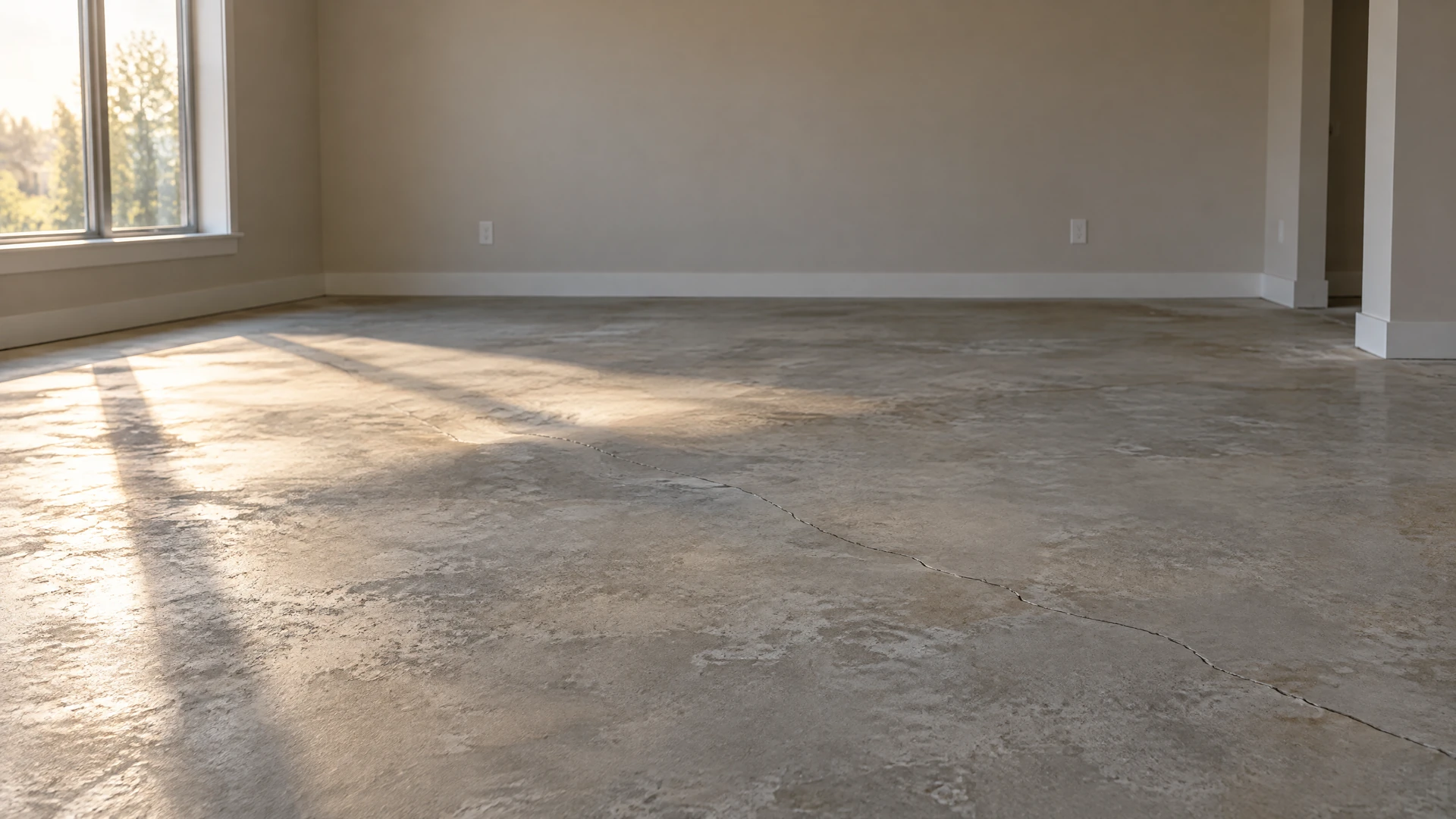
Almost every home in Spring, Klein, The Woodlands and Conroe sits on a concrete slab poured over expansive clay, and that clay swells in the wet season and shrinks in drought. Your slab moves with it. That single fact should change two decisions: you want a floating floor rather than a glued or nailed one in most rooms, and you want the slab moisture tested before anything goes down. Skip the moisture test and you can lose a floor that had nothing wrong with it.
Most flooring advice online was written for a house with a wood subfloor over a crawlspace or a basement. That house barely exists here. When a national article tells you to glue down your vinyl or nail your hardwood, it is describing a building that behaves nothing like yours.
The soils across Harris and Montgomery County are heavy in clay. Clay holds water, and when it takes water on it expands. When it dries out it contracts and pulls away. A Gulf Coast year gives it both extremes: long soaking rain events, then stretches of heat with almost nothing.
The slab poured on top of that clay is stiff, but it is not immovable. It rides the soil, and over a season the corners and the center can end up at slightly different heights. It is usually small, and in most houses it is nothing you would notice walking around. Your floor covering notices.
That is the part homeowners here get surprised by. The floor is not failing because the product was cheap. It is failing because it was attached to something that moved.
The pattern is easy to read once you see it. Anything that floats is tolerant.
Anything bonded or fastened to the slab inherits whatever the slab does.
That is not an argument against glue down, which is the right answer in a retail space or a warehouse office where rolling loads would shift a floating floor. It is an argument for matching the method to the building, which is a different question from matching the product to your taste.
A concrete slab holds water long after it looks and feels dry. Moisture moves up through it as vapor, and when it reaches the underside of a floor that does not breathe, it condenses. That is what lifts glue, cups planks and grows mildew under a floor that looked perfect at install.
There are two standard tests, and they are not equal.
ASTM F1869 is the calcium chloride test. A dish of salt sits on the slab under a sealed dome and gets weighed to work out how much vapor came off the surface in 24 hours. It is cheap and old. Its weakness is that it only reads the top layer, and a slab surface can read dry on a cool morning while the concrete two inches down is still wet.
ASTM F2170 is the in situ relative humidity probe. Holes are drilled into the slab, sleeves go in, and sensors read the humidity inside the concrete at depth, at 40 percent of slab thickness for a slab drying from one side. It reads the moisture that will actually come up over the next few years, not just what is at the surface today, and it is the method most flooring manufacturers now write into their warranty conditions.
Ask which one your installer runs. If the answer is neither, that is worth knowing before the material arrives.
A floating floor is a raft, and rafts need room to move.
Every floating installation needs a gap around the entire perimeter, at doorways, and at any run long enough that the manufacturer calls for a transition. Baseboard and quarter round hide it. The gap is what lets the floor grow and shrink with the seasons without pushing against a wall.
When a floating floor peaks up in the middle of a room, the cause is almost always that the gap was skipped, filled with caulk, or pinned by a heavy cabinet or a door casing that was never undercut. The planks had nowhere to go, so they went up. This matters more here than in a dry climate, because our indoor humidity swing between February and August is wide.
Our warranty terms call for indoor humidity to sit between 35 and 55 percent for hardwood and engineered wood. That is not fine print invented to deny claims. Wood moves with moisture in the air, and a house that runs at 25 percent all winter and 70 percent all summer is asking a wood floor to change size twice a year.
The practical version: leave the HVAC running when you travel in July, and know that gapping between boards in January is usually seasonal and closes back up. If nobody in the house is going to manage humidity, that is a real argument for rigid core LVP over wood, and there is no shame in it.
Sometimes the honest answer is that the slab is not ready.
Floating floors need flatness within the manufacturer's tolerance, commonly around 3/16 of an inch over 10 feet, and a slab that has moved can be outside that. The fix is grinding the high spots or pouring self leveling compound in the low ones. It adds a day and some cost, and it is far cheaper than replacing a floor that clicked apart because it was bridging a dip.
If you have active foundation movement, meaning doors that have started sticking, new stair step cracks in brick, or a slab crack that is getting wider, flooring is the wrong thing to buy this month. Get the foundation looked at first. New flooring over a moving slab is an expensive way to hide a problem that will come back through it.
For a typical slab home in 77373, 77389 or 77381, rigid core LVP in a floating install handles the widest range of what this climate and this soil do. Wood still wins on feel where humidity is managed, and carpet still wins in bedrooms. The point is not that one product beats the rest. It is that the slab under your house is a design constraint, and pretending otherwise is how people end up buying flooring twice.
Do I need a vapor barrier under flooring on a slab in Houston?
Yes, in nearly every case. Most floating floors here go down over a 6 mil poly vapor retarder or an underlayment with a barrier built in. Given how much moisture Gulf Coast slabs hold, treating the barrier as optional is a bad bet even when the slab tests dry.
Can I put solid hardwood on a slab?
You can, but a plywood subfloor has to be built over the slab first so there is something to nail into. That raises floor height, affects door clearances and appliance heights, and adds real cost. Most people who want that look end up in engineered hardwood.
How long does a slab need to cure before flooring?
New concrete is commonly given about 30 days per inch of thickness, so a four inch slab is often quoted at four months. That rule of thumb is only a starting point. The actual gate is an ASTM F2170 reading inside the manufacturer's limit, not a number of days on a calendar.
Why did my floating floor start clicking or popping?
Usually a hollow spot where the slab dips away under the plank, or a lost expansion gap. Neither is a product defect, both are fixable, and both are cheaper to catch early than to live with.
Does clay soil movement void my flooring warranty?
Most flooring warranties, ours included, exclude damage caused by structural shifts and water intrusion. The floor is warranted, the building is not. That is another reason to deal with a moving slab before you buy material.
Bring a photo of the room, the age of the house, and whether anything has started sticking or cracking. We will tell you what we would put down and what we would not, and if the honest answer is that the slab needs attention first, we will tell you that too.
Lonestar Flooring and Cabinets1208 W Riley Fuzzel Rd, Spring, TX 77373(281) 364-7788Serving Spring, Klein, The Woodlands, Conroe, Tomball, Porter and greater Houston
Related reading: Mils, Not Millimeters, Laminate vs Hardwood Flooring in Spring TX, Hardwood Flooring Installation in Spring TX
Browse our flooring collections, including Lonestar Luxury Vinyl and Lonestar Max. Read our full warranty terms.
Texas Style Wholesale

.svg)
.svg)