September 17, 2026
Face weight is the number every carpet showroom leads with, and on its own it is close to useless. A heavy carpet made from loosely twisted fiber will mat down in a hallway faster than a lighter carpet with a tight twist. The three specs that actually predict how a carpet ages are twist level, density and fiber type, in roughly that order. Face weight only means something once you know the other two.
Carpet is the flooring category where the marketing and the engineering have drifted furthest apart. Everything gets sold on softness, because softness is what you feel in the showroom in the eight seconds you touch it. Almost nothing about how soft a carpet feels tells you how it will look in three years.
Face weight is ounces of fiber per square yard, counting only the pile, not the backing. A carpet at 50 ounces has more raw material in the pile than one at 35.
More material is genuinely better, all else equal. The problem is that all else is almost never equal. Face weight says nothing about how that fiber is constructed, and construction is what determines whether the pile springs back or lies down for good.
Think of it as the weight of a rope with no information about how tightly it is wound. You know how much fiber you bought. You do not know what was done with it.
Twist level is how many times the yarn is twisted per inch, and it is the closest thing carpet has to an honest durability number.
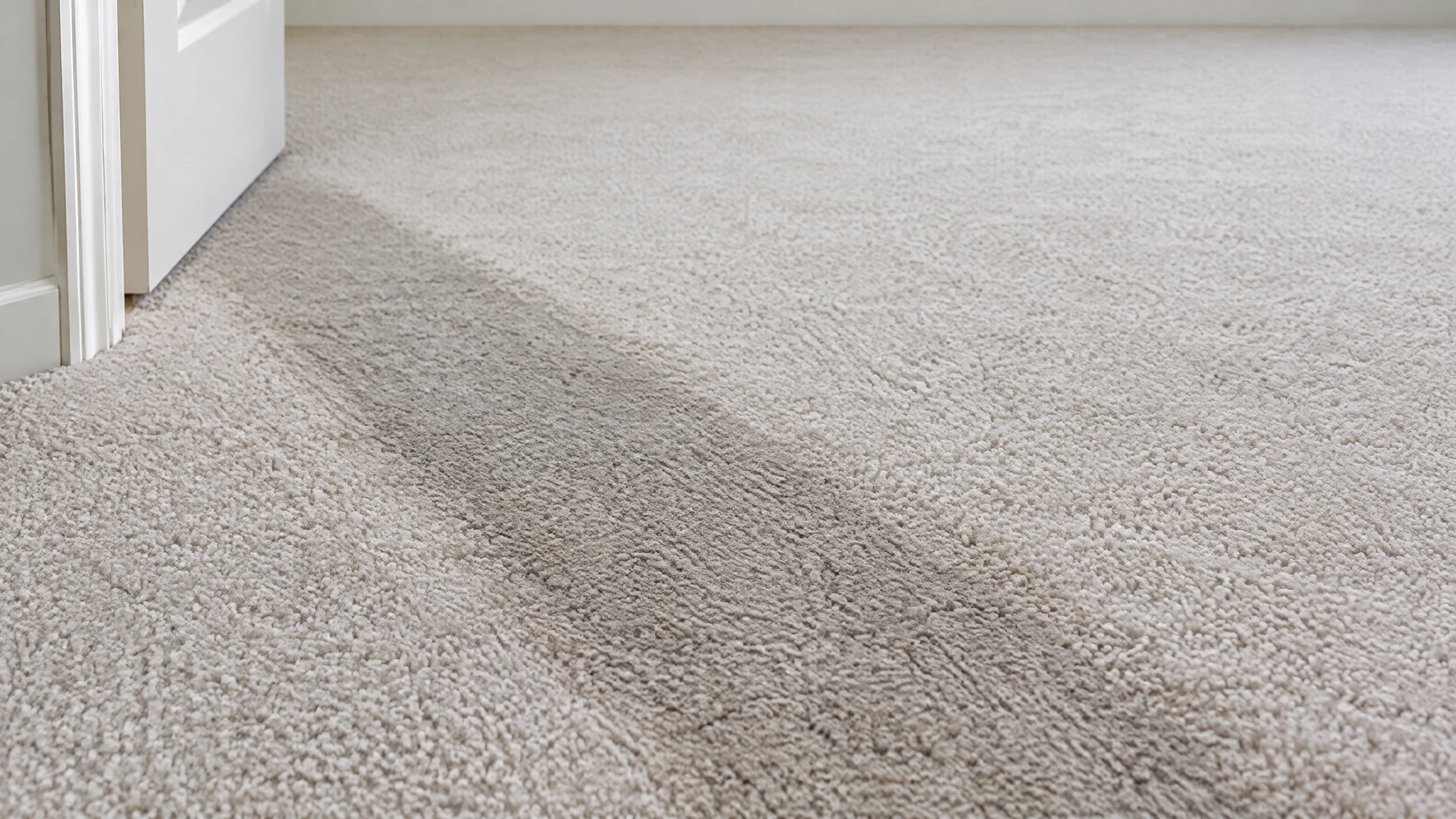
A tightly twisted yarn holds its shape. Walk on it, and the tuft stands back up. A loosely twisted yarn opens up under traffic, the fiber ends splay, and the carpet develops that dull, shaded, flattened look down the middle of a hallway. That is matting, and matting is what makes people replace carpet. It is almost never actual wear through. The carpet is still there. It just looks tired.
Higher twist runs roughly 5 to 6 turns per inch and up. Anything advertised primarily on plushness is often lower, because a tight twist and a cloud soft hand pull in opposite directions.
Here is the tradeoff stated plainly, because showrooms rarely do:
This is why the same carpet can be a great bedroom choice and a poor hallway choice. It is not a quality difference. It is a fit difference.
Density is how close together the tufts are stitched. A dense carpet has less space between fibers, which means less room for a tuft to bend sideways under a footstep.
The showroom test costs nothing. Fold a sample back on itself, pile side out, into a tight U. If the backing grins through the fibers easily, that carpet is not dense. On a dense sample the backing barely shows. Do that with every sample one after another, because the differences are obvious back to back and invisible one at a time.
Density also does quiet work you will appreciate later. A dense carpet holds less soil deep in the pile and vacuums cleaner as a result.
Nylon is the most resilient common carpet fiber. It recovers from crushing better than the alternatives and takes solution dyeing and stain treatments well. It also costs more.
Polyester, including the PET fibers made from recycled bottles, is inherently stain resistant in a way nylon is not, because the fiber itself does not absorb much. It comes in beautiful colors and is easier on the budget. It is less resilient, which means it relies more heavily on twist and density to avoid matting.
Polypropylene, or olefin, resists moisture and fading and is common in loop constructions. In a cut pile it mats readily.
The honest summary: in a low traffic bedroom, a well built polyester is a smart buy and the resilience gap barely shows. In a hallway, a stair, or a family room with dogs and kids, nylon earns its price. Anyone who tells you one fiber is simply better is selling whichever one they have.
People spend weeks choosing carpet and thirty seconds choosing pad. Then the carpet fails early and the carpet gets blamed.
Pad is the shock absorber. Every footstep that pad absorbs is a footstep the carpet fiber does not have to absorb. The wrong pad shortens carpet life measurably, and most carpet warranties specify a pad range, which means the wrong pad can also cost you the warranty.
The mistake people make is assuming thicker and softer is better. It is not. A pad that is too thick lets the carpet flex too much at the backing, which breaks down the backing and can open seams. For most residential cut pile, a pad around 7/16 inch at roughly 8 pound density is a sane default, and firmer is better on stairs and in high traffic runs.
Check what the carpet manufacturer specifies before you buy pad, not after.
Houston area homes run humid, and slab construction means most carpet here sits over concrete rather than over a wood subfloor. Concrete gives up moisture as vapor for years and stays cooler than room air, which makes the underside of a carpet a place where moisture likes to sit.
Two practical consequences. If a room has ever taken water, deal with the slab moisture before new carpet goes over it, because carpet and pad will hold humidity against concrete quite happily. And running the HVAC while you are away in summer is not just about comfort. A closed up house in August is a good way to find out what your carpet backing smells like at 80 percent humidity.
If a room floods, pad is a replace item, not a dry out item, essentially every time.
We sell a lot of carpet and we will still tell you when to skip it.
Skip carpet in an entry, a bathroom or a laundry room. Skip it where someone has significant dust or dander allergies and hard surface plus washable rugs will serve better. Skip it in any space with a known moisture history, and reconsider it in a house with an incontinent pet, because subfloor contamination is not something cleaning solves.
If you are listing a house in Spring or The Woodlands in the next year, carpet in main living areas reads as dated to a lot of buyers right now, whatever its quality. Bedrooms are a different story.
Room dimensions, a rough traffic ranking of the rooms, whether there are pets, and whether stairs are involved. Stairs punish carpet harder than any other surface in a house and deserve their own spec conversation.
Then fold the samples. Compare the twist. Ask for the pad requirement in writing.
What is a good carpet face weight?
For residential use, 35 to 60 ounces covers most of the market, with 40 to 50 being a common sweet spot. Treat it as a budget signal rather than a durability guarantee. A 40 ounce carpet with a tight twist and high density will outlast a 55 ounce carpet with neither.
How long should carpet last?
Roughly 5 to 15 years, and the spread is mostly explained by construction, pad quality, traffic and vacuuming habits rather than by price alone. Most carpet is replaced because it looks matted, not because it has worn through.
Is expensive carpet padding worth it?
Getting the right pad matters far more than getting the most expensive one. Match the density and thickness the carpet manufacturer specifies. Too thick or too soft actively shortens carpet life and can void coverage.
Which carpet is best with dogs?
A solution dyed nylon or a quality polyester in a low, dense, tight twist cut pile. Avoid long loose loops, which claws pull. Solution dyed fiber has the color built into the fiber, so it survives aggressive spot cleaning better.
Can carpet go over a concrete slab?
Yes, and most carpet in this area does. Use a pad appropriate for slab installation and make sure the slab is dry first. Carpet and pad hold moisture against concrete, so an untested wet slab is the one situation where carpet will disappoint you quickly.
How often should carpet be professionally cleaned?
Most manufacturers require professional hot water extraction every 12 to 18 months to keep the warranty intact, and ask you to keep the receipts. That requirement surprises people at claim time.
We carry carpet across the range, from everyday budget goods to high end wholesale, and we will tell you which one belongs in your hallway and which one belongs in your guest room. They are usually not the same carpet.
Lonestar Flooring and Cabinets1208 W Riley Fuzzel Rd, Spring, TX 77373(281) 364-7788Serving Spring, Klein, The Woodlands, Conroe, Tomball, Porter and greater Houston
Browse our carpet collections: Lonestar Plush, Lonestar Cloud 9, Lonestar Comfort, Lonestar Oasis, Lonestar Heaven's Door and Commercial Carpet Tiles.
Related reading: Flooring for Slab Foundations in Spring TX, Flooring for Aging in Place
Texas Style Wholesale

.svg)
.svg)