October 19, 2026
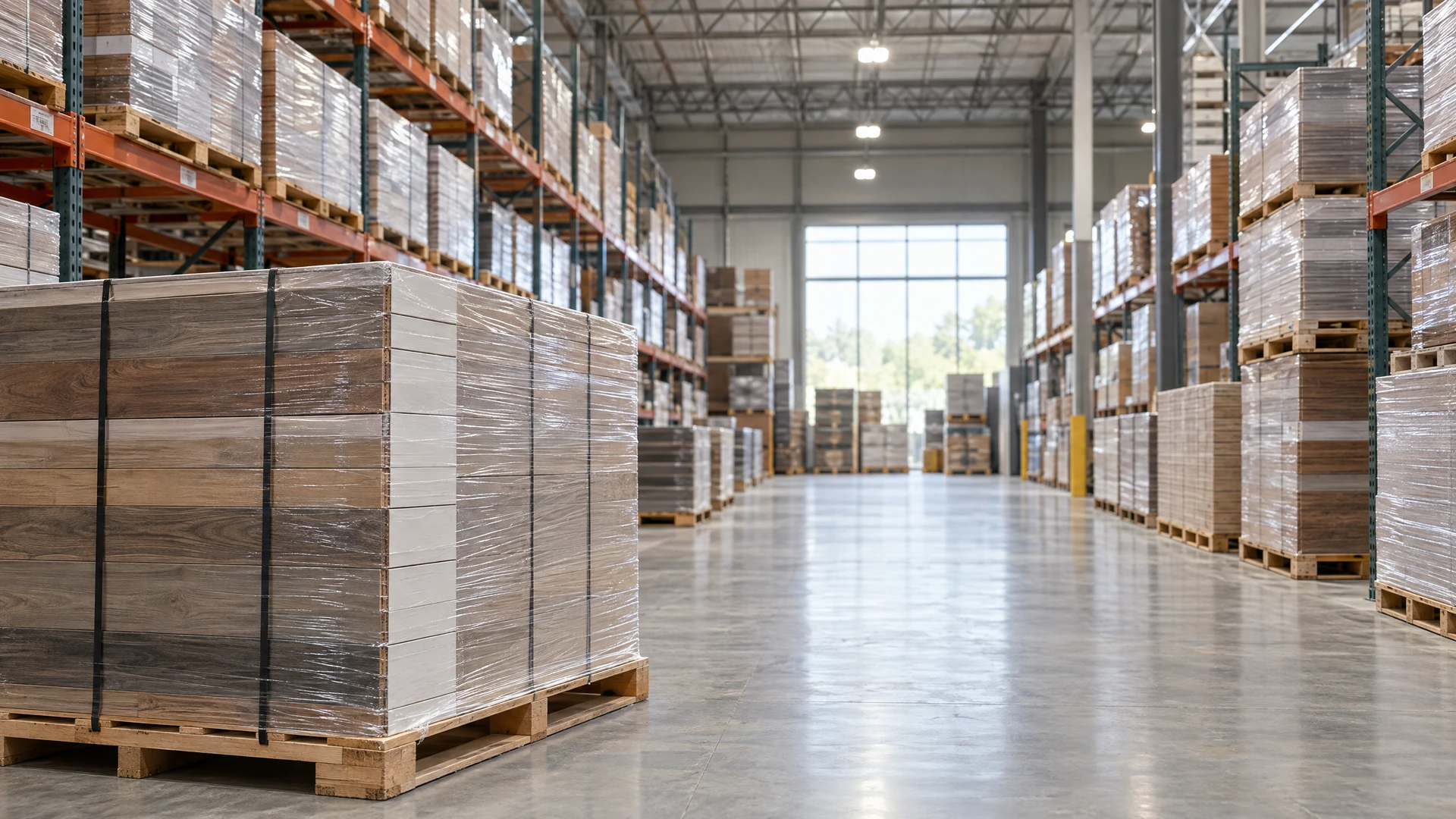
The same plank can reach two houses at meaningfully different prices, and the reason is usually how many businesses it passed through on the way. A typical box of flooring travels from a mill to a distributor to a retailer before it reaches an installer. Each stop adds cost, and each stop is adding it for real reasons rather than out of greed. What lowers a price is removing a layer or committing to volume. It is not the word wholesale on a sign, which means nothing in particular and is not regulated by anyone.
This is the part of the business almost nobody explains to customers, partly because explaining it invites questions. It is worth understanding, because it tells you which price claims to believe and what questions actually get you a better number.
The mill manufactures the product. Mills run enormous volume and sell in enormous volume, typically by the container or the truckload. A mill is not set up to sell you nine boxes of a single colorway.
The distributor buys in mill quantities and breaks it down. This layer exists to solve a real problem: a retailer in Texas cannot practically commit to a container of every product they show. The distributor warehouses inventory, carries the credit, handles freight, runs a sales force, processes returns and claims, and absorbs what does not sell.
The retailer shows the product, keeps samples, advises on specification, and sells in the quantities a house actually needs. This layer carries the showroom, the staff and the cost of your time.
The installer supplies labor, and is sometimes the same business as the retailer and sometimes not.
Every one of those layers has payroll, freight, warehouse space and shrinkage. Trade analysis of the flooring business has put the operating cost of running a distribution operation at roughly a fifth of sales. That number is not a markup somebody invented. It is what it costs to hold inventory and deliver it.
If a retailer buys in mill quantities directly, the distributor's cost structure comes out of the chain. Some of that shows up in the price.
The trade does not hand this over for free. Buying direct means committing to volume, financing inventory that sits in a warehouse until it sells, absorbing freight, eating what does not move, and accepting responsibility for quality control that a distributor would otherwise handle. A business that buys direct is taking on risk in exchange for cost.
That is also the honest answer to why a direct buyer usually carries a focused set of collections rather than everything in the catalog. Depth in a defined range is what makes volume buying possible. Breadth across thousands of products is exactly what requires a distributor.
A private label floor is manufactured by an established mill and sold under the seller's own name rather than the manufacturer's brand.
The thing people assume is that private label means lower quality. It does not, inherently. It means you are not paying for the brand's national advertising, and it means the spec sheet matters more than the name, because you cannot look up reviews of a name only one company sells.
This cuts both ways honestly. A private label product with a documented wear layer, a real warranty and a mill behind it is often the same construction as a branded product at a lower price. A private label product with no published specification is a product nobody wants to be accountable for. The difference is whether the seller will put the numbers in writing.
Nobody regulates the word. A business can print wholesale on the building whatever its pricing looks like.
So treat it as a claim to test, not a fact. These questions do the testing:
A seller who answers all six quickly is probably pricing honestly. A seller who deflects to adjectives is selling on adjectives.
Most price comparisons are invalid because the two products are not the same product.
Compare specification, not name. A 12 mil wear layer plank and a 20 mil wear layer plank are different goods, and the cheaper one is not a better deal, it is a different item with a different service life. Our own guide to wear layer and core construction covers how to read those numbers.
Compare per square foot, not per box. Box coverage varies between products, and a cheaper box can be a more expensive floor.
Compare installed, not material only. Material is often less than half of what a finished floor costs. A low material price attached to expensive labor is not a saving.
We sell this way and we will still tell you when it does not apply.
If you need one box for a closet this afternoon, a big box store will almost certainly serve you better and cheaper, because they stock for exactly that. If your job is small enough, the difference on a few hundred square feet may not be worth the trip. If you need a specific national brand the design has already specified, a direct buyer may simply not carry it.
And loss leaders are real. A retailer running a promotion on a specific product can beat anyone on that product, because they are pricing it to get you in the door. That is a genuine saving on that item, and it is not evidence about anything else in the store.
The volume model shows its advantage on whole rooms, whole floors and whole houses, and on repeat orders. On a bathroom, it often does not.
Is wholesale flooring lower quality than retail flooring?
No. Wholesale describes how the product is bought and sold, not how it is made. Quality is determined by the wear layer, the core construction and the warranty. Ask for those figures in writing and compare them directly, regardless of what the seller calls itself.
Why is flooring so expensive?
Material is usually less than half of a finished floor. The rest is labor, subfloor prep, underlayment, transitions, trim, tear-out and disposal. Add the freight and warehousing behind the material itself, and the per square foot number covers far more than the plank.
Can homeowners buy flooring at wholesale pricing?
At some suppliers, yes. It depends on the business model rather than on your status. The practical question is whether the seller requires a trade account or sells the same way to everyone.
What does private label flooring mean?
It is manufactured by an established mill and sold under the seller's own name. It avoids the cost of a national brand's marketing. Judge it by its published specification and warranty, not by the absence of a familiar name.
How do I compare two flooring quotes fairly?
Match the specification first, especially wear layer and thickness. Then compare per square foot rather than per box. Then compare the installed figure including prep, transitions and disposal. Two quotes on different products are not a comparison.
Does buying direct mean less selection?
Usually yes, and deliberately. Buying in mill quantities requires depth in a focused range. Breadth across thousands of products is precisely what the distribution layer exists to provide.
Bring the list above to us, or to anyone else. We will answer all six with numbers, and we will tell you when a big box store is the better answer for the job you actually have.
Lonestar Flooring and Cabinets 1208 W Riley Fuzzel Rd, Spring, TX 77373 (281) 364-7788 Serving Spring, Klein, The Woodlands, Conroe and greater Houston
Related reading: Mils, Not Millimeters, Flooring Store or Home Improvement Store?
Browse our collections, or see the builder and contractor programs.
Texas Style Wholesale