October 22, 2026
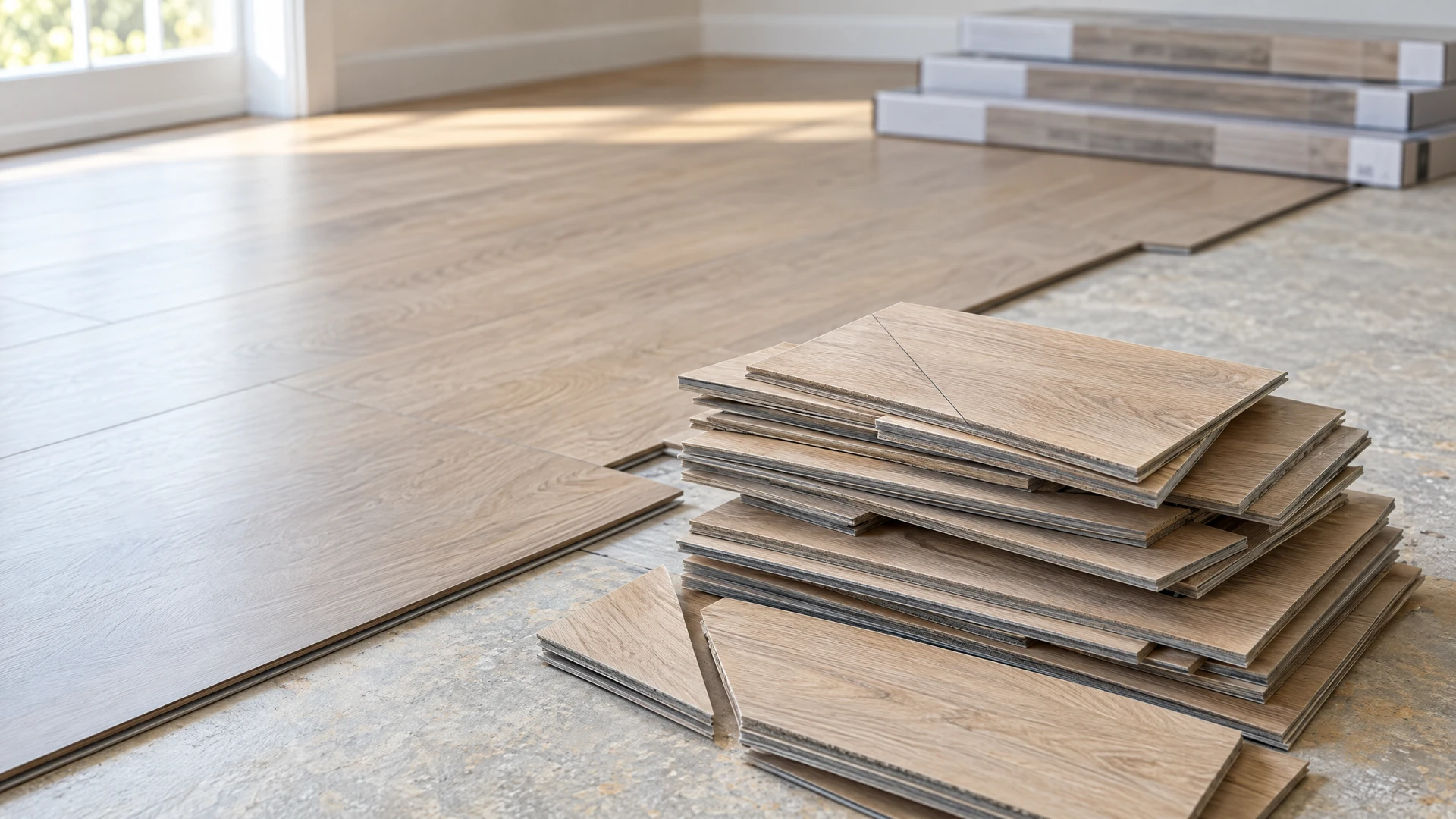
Order the exact square footage of your rooms and you will run out. Every installation loses material to cuts, and the loss is larger with wider planks, busier room shapes and any pattern that is not a straight lay. Add a waste factor to the first order, between about 7 and 10 percent for a straight lay and up to 15 to 17 percent for a pattern, then add one more unopened box on top. That last box is the cheapest insurance in the whole project, because a replacement ordered later will likely come from a different production run and will not match.
This is the mistake that costs the most for the least reason. It is entirely avoidable and it takes about five minutes of arithmetic.
Material is lost in ways that have nothing to do with anyone's skill.
Every row ends at a wall, and the cut piece is only reusable if it is long enough to legally start the next row. Most manufacturers require end joints to be staggered by a minimum distance, so short offcuts get discarded rather than used. Doorways, closets, kitchen islands and any curve create cuts that produce scrap. Wider planks make bigger scrap, because a leftover from a 7 inch plank cannot be trimmed down to serve as a 5 inch one.
The result is that waste rises with plank width, room complexity and pattern, and it is not a sign that anything went wrong.
Typical starting points. Your installer's number for your specific rooms beats any table.
Then adjust upward for the things a table cannot see:
A diagonal layout takes substantially more material than a straight one. Herringbone is the extreme case, because every plank is cut at both ends.
Flooring is made in production runs. Within a run, color and texture are controlled tightly. Between runs, they drift slightly. The industry calls these dye lots, batches or run numbers depending on the material.
A slight drift is invisible when two lots sit in separate rooms and obvious when they sit in the same room under the same light.
This is not a small print technicality. Manufacturers say so plainly. One LVP manufacturer's guidance states that color, shade and texture may vary between batches, that batches should be inspected and compared before installation if they must be mixed, and that once flooring is installed, claims based on variations in color, shade and texture will be declined.
Read that last part again. Mixing lots is not a risk somebody else absorbs. Once it is down, it is yours.
So the rule is simple: order everything you need, including waste, in one order, from one lot. A second order placed two weeks later is a different production run more often than not.
After the floor is finished, keep one full unopened box from the original order. Label it with the product name, the colorway and the lot or run number, and put it somewhere dry and climate stable. Not the garage attic in a Houston summer, where heat cycling will not do a laminate or engineered product any favors. A closet shelf is better.
You will want it for one of three reasons. A dishwasher leak damages a few planks. Someone drops something heavy. A pet has a very bad day. In each case the repair is a handful of boards, and having matching material turns a floor replacement into an afternoon.
Flooring lines turn over fast. A colorway bought four years ago may be discontinued, and even a current line will be a different run. Our article on flooring and insurance claims covers what happens when you need to match a floor and cannot, which in Texas is a more expensive problem than most homeowners expect.
Measure each room length times width in feet, and treat irregular rooms as two or three rectangles added together. Add the totals. Do not subtract for islands or cabinets unless they are permanent and floor to floor, and when in doubt, do not subtract.
Multiply by your waste factor. Then divide by the square feet per box, which is printed on the carton and varies between products, and round up to the next whole box. Then add one more box for attic stock.
Two cautions. Box coverage differs between products, so never assume the box count from a previous job transfers. And closets count, including the parts nobody sees.
There is a limit, and the limit is usually the return policy.
Special order and custom colorways are frequently non returnable, so an over-order on those is money spent rather than money parked. Ask what the return window and restocking terms are before you decide how much cushion to carry. On a stocked product with a reasonable return policy, being generous costs almost nothing. On a special order, be precise and buy exactly one spare box rather than three.
And if you are doing one small room in a product you will never need to match again, the attic stock argument mostly falls away. Keep a few planks rather than a box.
How much extra flooring should I order?
About 7 to 10 percent over your measured square footage for a straight lay, and up to 15 to 17 percent for diagonal or herringbone patterns. Add more for wide planks, complex rooms or DIY installation, then one extra unopened box for future repairs.
What is a dye lot in flooring?
A production run. Color, shade and texture are controlled within a run and can vary slightly between runs. Two lots in the same room often show a visible difference, which is why the whole order should come from one lot.
Can I install flooring from two different batches?
Manufacturers advise against it. If it cannot be avoided, the lots should be compared before installation. Be aware that many manufacturers decline warranty claims about color and shade variation once flooring is installed.
Do I need to order extra flooring for closets?
Yes. Closets are floor area and consume material like any other space, and they often add cuts because of their size and door openings. Include them in the measurement.
Where should I store leftover flooring?
Somewhere dry with stable temperature, such as an interior closet. Avoid an attic or an uninsulated garage, where Gulf Coast heat cycling can affect laminate and engineered products before you ever need them.
What if I run out mid installation?
Stop and order before the crew keeps going. Finishing a visible area with a second lot is the worst outcome. If a second lot is unavoidable, use it in a closet or a separate room rather than continuing the same run.
Bring your measurements or your plans and we will work out the boxes, including the waste factor for your specific layout and the spare box. Getting it right at order is free. Getting it wrong costs a second delivery and sometimes a second dye lot.
Lonestar Flooring and Cabinets 1208 W Riley Fuzzel Rd, Spring, TX 77373 (281) 364-7788 Serving Spring, Klein, The Woodlands, Conroe and greater Houston
Related reading: What Is Actually in a Flooring Quote, How Flooring Pricing Actually Works, Flooring and Insurance Claims in Texas
Browse our collections.
Texas Style Wholesale